JCAST - Junction Centric Alternative Splicing Translator
Alternative splicing, proteomics, mass spectrometry, RNA sequencing, protein isoforms, proteoforms
- Maggie Lam Lab, Depts of Medicine; Biochemistry & Molecular Genetics, University of Colorado School of Medicine
- Edward Lau Lab, Dept of Medicine, University of Colorado School of Medicine

About JCAST
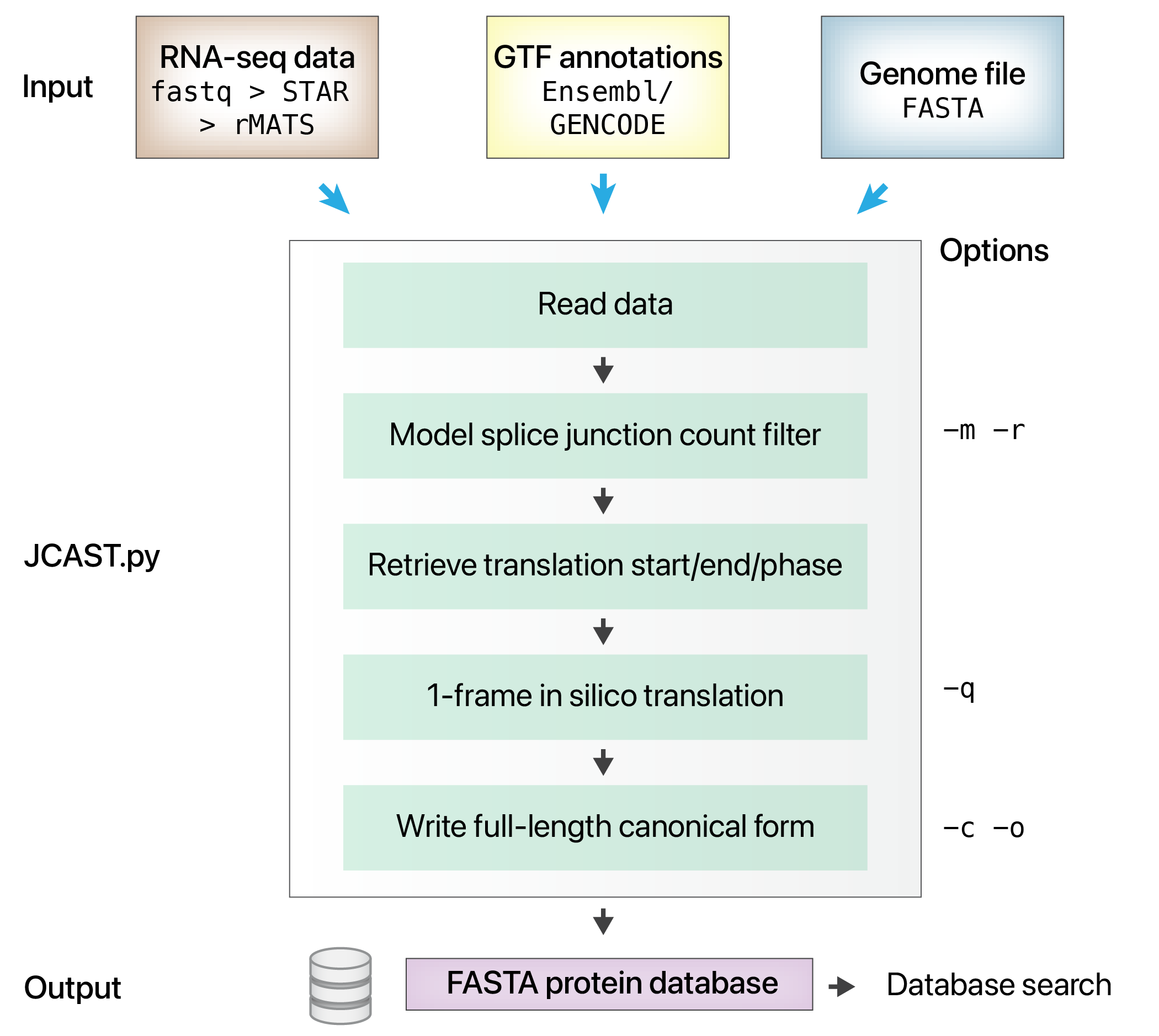
JCAST (Junction Centric Alternative Splicing Translator) is a Python software that takes in splicing events from RNA sequencing data to create custom protein sequence databases for protein isoform analysis.
JCAST attempts to create small protein sequence databases that contain only likely sequences in mass spectrometry experiment samples to avoid runaway database size inflation.
To do so, JCAST selects likely translatable alternative splice junctions, translates each in its annotated reading frame, then joins the translated variant sequences to full-length canonical sequences.
Downloads
Latest Updates
v0.4.0 (November 13, 2026)
- Corrected translation and tiering. Re-run analyses made with v0.3.5a.
--uniprot: canonical proteins from a downloaded UniProt FASTA- About 25× faster on a whole genome;
-pfor several processes junctions.tsv: every junction’s outcome- Requires Python 3.11 or later
See Change Log for details.
JCAST is on PyPI and requires Python 3.11 or later:
$ pip install jcastThe source code is on GitHub: https://github.com/ed-lau/jcast.
See the Quick Start and Documentation for instructions.
Contributors
- Edward Lau, PhD - ed-lau
- Maggie Lam, PhD - Maggie-Lam
- R W Ludwig, BSc - WesLudwig
Citations
JCAST: Sample-Specific Protein Isoform Databases for Mass Spectrometry-based Proteomics Experiments. RW Ludwig, E Lau Software Impacts 10, 100163 Link
Determining Alternative Protein Isoform Expression Using RNA Sequencing and Mass Spectrometry. Y Han, JM Wright, E Lau, MPY Lam STAR Protocols 1 (3), 100138 Link
Splice-Junction-based Mapping of Alternative Isoforms in the Human Proteome. E Lau, Y Han, DR Williams, CT Thomas, R Shrestha, JC Wu, MPY Lam Cell Reports 29 (11), 3751-3765. e5 Link